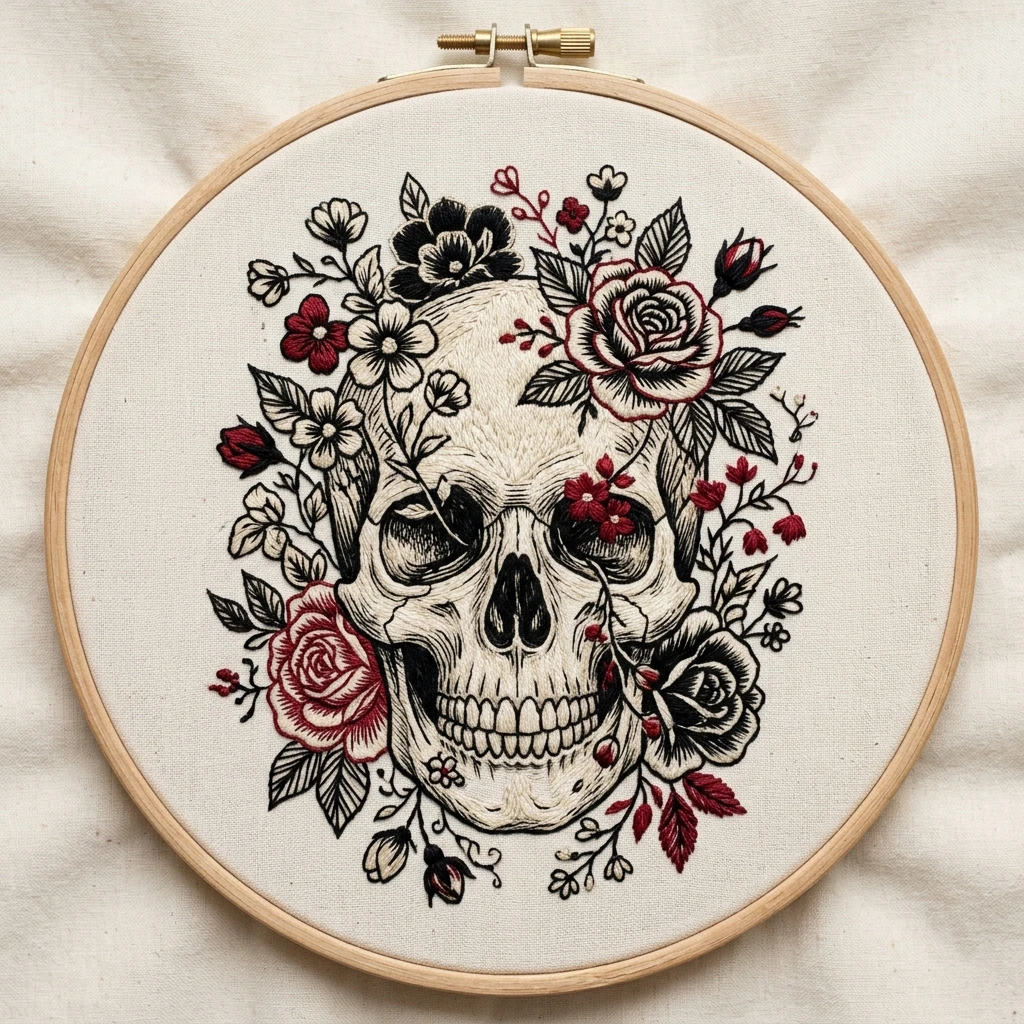
A detailed human skull fills the center of the embroidery hoop, surrounded by large roses, small blossoms, buds, leafy stems, and curling botanical sprigs. Black linework gives the skull and foliage a dramatic engraved look, while deep crimson accents make the flowers stand out against the natural fabric.
Free Pattern Download
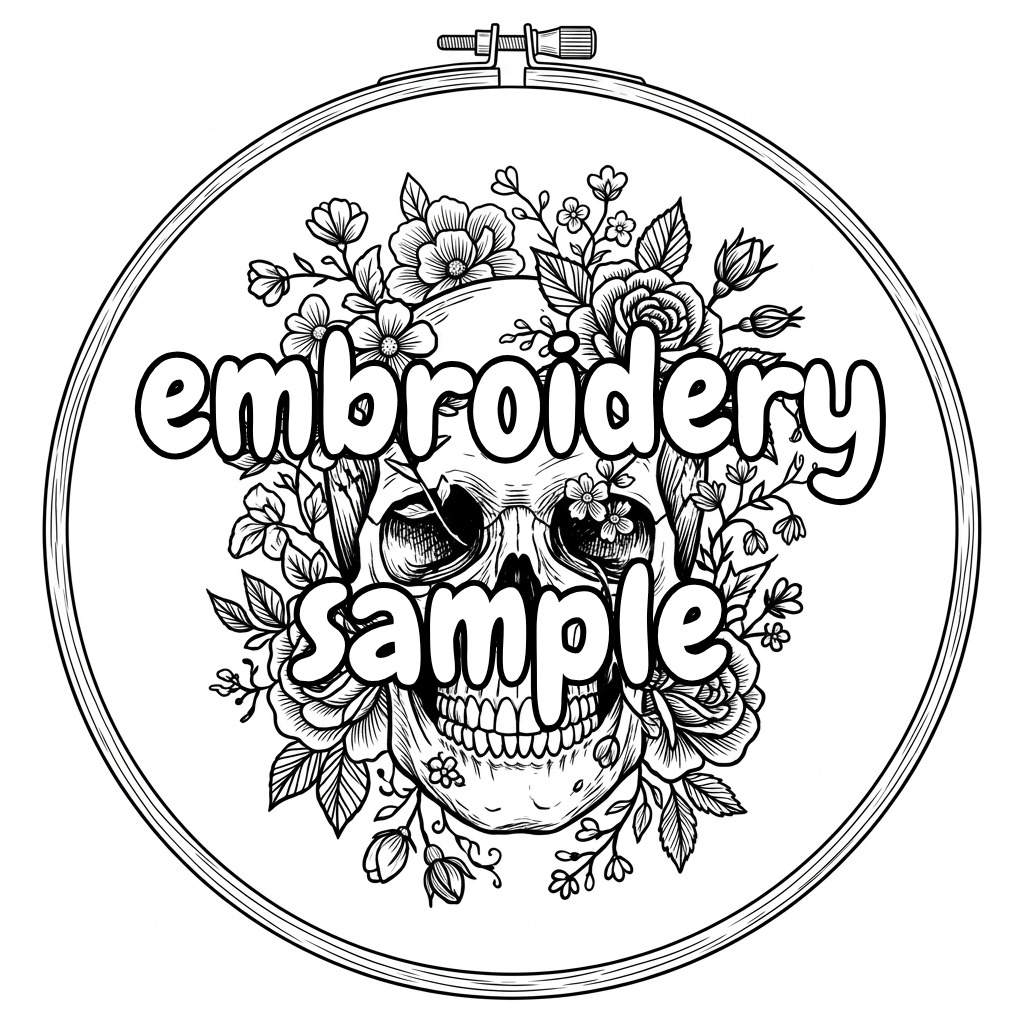
Get the printable pattern PDF and the pixelized cross-stitch chart. Click the button below to prepare your files.
Your files will be ready in 60 seconds.
Preparing your files…
This takes about 60 seconds.
Your files are ready. Happy stitching!
Opens a Google Drive folder with the pattern PDF and the pixelized chart inside.
Design Read
The composition is built around a frontal skull with dark eye sockets, a black nasal cavity, individually defined teeth, and many fine contour marks that suggest bone texture and shadow. Floral clusters overlap the forehead, temples, cheeks, and lower jaw. The largest rose sits at the upper right, with additional roses at the lower left and lower right. Smaller five-petal flowers, closed buds, berries, narrow leaves, and branching stems fill the remaining spaces. The limited black, ivory, and wine-red palette keeps the hoop art bold, graphic, and cohesive.
Recommended DMC Color Palette
Use the palette as a practical map. The skull depends on subtle neutral shading, while the roses and buds benefit from a compact range of deep reds.
| DMC | Color | Suggested use |
|---|---|---|
| 310 | Black | Eye sockets, nasal cavity, deepest outlines, petal shadows, stems, and leaf contours. |
| 3799 | Pewter Gray Very Dark | Softened skull shadows, teeth separations, and dark transitions beside pure black. |
| 413 | Pewter Gray Dark | Mid-shadow hatching around the brow, cheekbones, temples, and jaw. |
| 317 | Pewter Gray | Subtle bone modeling and lighter etched texture lines. |
| 3865 | Winter White | Optional highlights on teeth, forehead, cheekbones, and pale flower centers. |
| 814 | Garnet Dark | Deepest red rose folds, shaded buds, and dark berry accents. |
| 815 | Garnet Medium | Main crimson petals, small flowers, and red leaf accents. |
| 816 | Garnet | Brighter petal planes and mid-tone floral fills. |
| 304 | Christmas Red Medium | Selective highlights on petals and small blossoms. |
| 498 | Christmas Red Dark | Rich transitions between 814 and 816 in larger roses. |
| 938 | Coffee Brown Ultra Dark | Optional warm-soft outline alternative for selected bone contours. |
| 644 | Beige Gray Medium | Optional quiet neutral accents if the skull needs more separation from the fabric. |
Stitch Plan by Design Area
Skull outline and contours
Use one-strand split stitch or stem stitch in DMC 310. Follow every curve cleanly around the cranium, cheekbones, jaw, and teeth rather than using long unsupported lines.
Eye sockets and nasal cavity
Fill the darkest shapes with closely packed satin stitch or short-and-long stitch in 310. Feather the edges with 3799 so the cavities feel deep without becoming flat black blocks.
Bone shading
Build fine directional hatching with one strand of 3799, 413, and 317. Curve the stitches around the forehead, brow ridges, temples, eye rims, cheekbones, and lower jaw.
Teeth
Outline the full tooth row first, then divide each tooth with tiny back stitches. Add a few short gray marks near the roots and between teeth; keep the centers mostly open.
Large roses
Trace petal edges with split stitch. Shade each petal from 814 or 498 at the fold into 815 and 816, reserving 304 for small highlights. Short-and-long stitch works best for the curved petals.
Small flowers and buds
Use satin stitch for compact petals, French knots for small centers, and detached chain stitches for tiny buds. Alternate red and black details to preserve the image’s limited palette.
Leaves
Work fishbone stitch or angled straight stitches in 310. Leave narrow slivers of fabric between vein groups where the reference shows striped leaf texture.
Stems, berries, and sprigs
Use one-strand stem stitch for branches, straight stitch for thorns and small offshoots, and French or colonial knots for the smallest berry-like dots.
Thread Count & Blending Guide
Fine linework
Use 1 strand for skull contours, tooth divisions, hatching, leaf veins, narrow stems, and delicate petal outlines.
Main fills
Use 2 strands for rose petals, larger black flowers, dense leaf fills, and the broader areas inside the eye sockets.
Raised accents
Use 3 strands sparingly for bold French knots, prominent flower centers, or a few deeply shadowed petal folds.
| Blend | Where to use | Effect |
|---|---|---|
| 1 strand 310 + 1 strand 3799 | Eye rims, cheek shadows, and deep bone contours | Softer than solid black while retaining strong definition |
| 1 strand 3799 + 1 strand 413 | Forehead, temples, and jaw shading | Controlled graphite-like transition |
| 1 strand 814 + 1 strand 815 | Deep folds in the large roses | Rich wine-red depth |
| 1 strand 815 + 1 strand 816 | Mid-petal transitions and small flowers | Smooth crimson modeling |
| 1 strand 816 + 1 strand 304 | Selective petal highlights | Brighter red lift without turning pink |
Outlining, Shading & Texture Suggestions
Keep the skull linework disciplined
The engraved effect comes from many short, directional marks. Use tiny curved stitches instead of long straight lines, and vary the spacing so the bone does not look mechanically striped.
Shade around the form
Let stitch direction follow the round forehead, hollow eye rims, sloping cheekbones, and cylindrical teeth. Darken the underside of forms and keep the upper planes lighter.
Build roses from the center outward
Begin with the darkest curled center, then work each surrounding petal in turn. Place the darkest red at folds and overlaps, with lighter red toward exposed edges.
Use selective black fills
Not every flower or leaf needs to be solid. Mix open linework, striped fishbone texture, and dense black areas so the design remains readable and does not become visually heavy.
Beginner-Friendly Practical Tips
Use a fine water-soluble pen or transfer paper. The tooth row and flower overlaps need especially accurate tracing.
Complete the skull before the flowers that overlap it, but leave the overlapping boundary lines unstiched until the foreground petals are placed.
Use 35–40 cm lengths. Black and dark red floss can fuzz quickly when repeatedly pulled through dense areas.
Compare both eye sockets and both sides of the tooth row before filling them. Small corrections are easier before dense stitching begins.
Wash hands before stitching and cover completed areas with clean tissue while working on nearby dark fills.
Preserve small areas of exposed fabric within petals, leaves, and around the skull so the black-and-red design stays crisp.
Quick Working Recipe
- Transfer the skull, teeth, major roses, flowers, leaves, and stems onto tightly hooped natural fabric.
- Outline the skull and tooth row with one strand of DMC 310, using short split or back stitches.
- Fill the eye sockets and nasal cavity, then soften selected edges with 3799.
- Add fine gray hatching to shape the brow, temples, cheekbones, jaw, and tooth roots.
- Stitch the large roses from their dark centers outward, blending 814, 815, 816, 498, and small touches of 304.
- Complete the smaller blossoms, buds, flower centers, and berries with satin stitch, detached chain, and knots.
- Finish leaves and stems with fishbone, stem, and straight stitches, maintaining the strong black botanical linework.
- Inspect the whole hoop, reinforce only the darkest overlaps, remove transfer marks, and press carefully from the reverse.